

Content
Water Damage Restoration Cost in Toronto (2026)
By CSG Renovation · Updated November 2026
Quick answer: At CSG, emergency water damage restoration in Toronto typically costs $1,500 to $3,000 for one area of clean water caught early, and $3,000 to $5,500 for several rooms of clean or grey water. Across Canada, most water damage jobs cost about $3,000 to $10,000, and a sewer backup or full basement rebuild can cost $15,000 to $50,000 or more. Prices are before HST. The biggest factors are the type of water, how much area got wet, and how quickly drying starts.
Key points:
- Drying only (extraction and drying) typically costs about $4 to $7 per square foot. Drying plus rebuilding typically costs about $8 to $15 per square foot.
- Speed saves money. Health Canada advises that homes and furnishings are less likely to grow mould if dried within 48 hours.
- The type of water matters most. Clean water from a pipe costs far less to restore than sewage, because contaminated materials must be removed, not dried.
- Insurance depends on the cause. A sudden burst pipe is usually covered. A sewer backup usually needs a sewer backup endorsement, and water from outside usually needs an overland water endorsement.
- Our own equipment means drying starts on the first visit. CSG crews arrive with their own extraction and drying equipment, so there’s no wait for rented machines.
- One contractor from water to finished room avoids paying two companies and waiting between them.
Request a water damage assessment → · Call (647) 428-0007
What CSG charges for emergency water damage restoration
These are CSG’s typical prices for emergency water mitigation in Toronto, before HST:
| Situation | What’s included | Typical CSG price (before HST) |
|---|---|---|
| One area, clean water, caught early | Extraction, drying and dehumidification | $1,500 – $3,000 |
| Several rooms, clean or grey water | Extraction, drying, antimicrobial treatment and removal of wet drywall | $3,000 – $5,500 |
| Sewage, black water and whole-floor losses | Priced after inspection, because what has to come out depends on what we find inside the walls | After inspection |
These prices cover getting the water out and the structure dry. Repairs after drying, such as new drywall, flooring and paint, are priced separately, and CSG can do them as well.
How that compares: a Toronto renovation company’s 2026 guide puts minor one-room damage at $1,500 – $4,000 and moderate damage across several rooms at $4,000 – $12,000. CSG’s ranges sit at the low end of both.
Typical water damage restoration costs in Canada
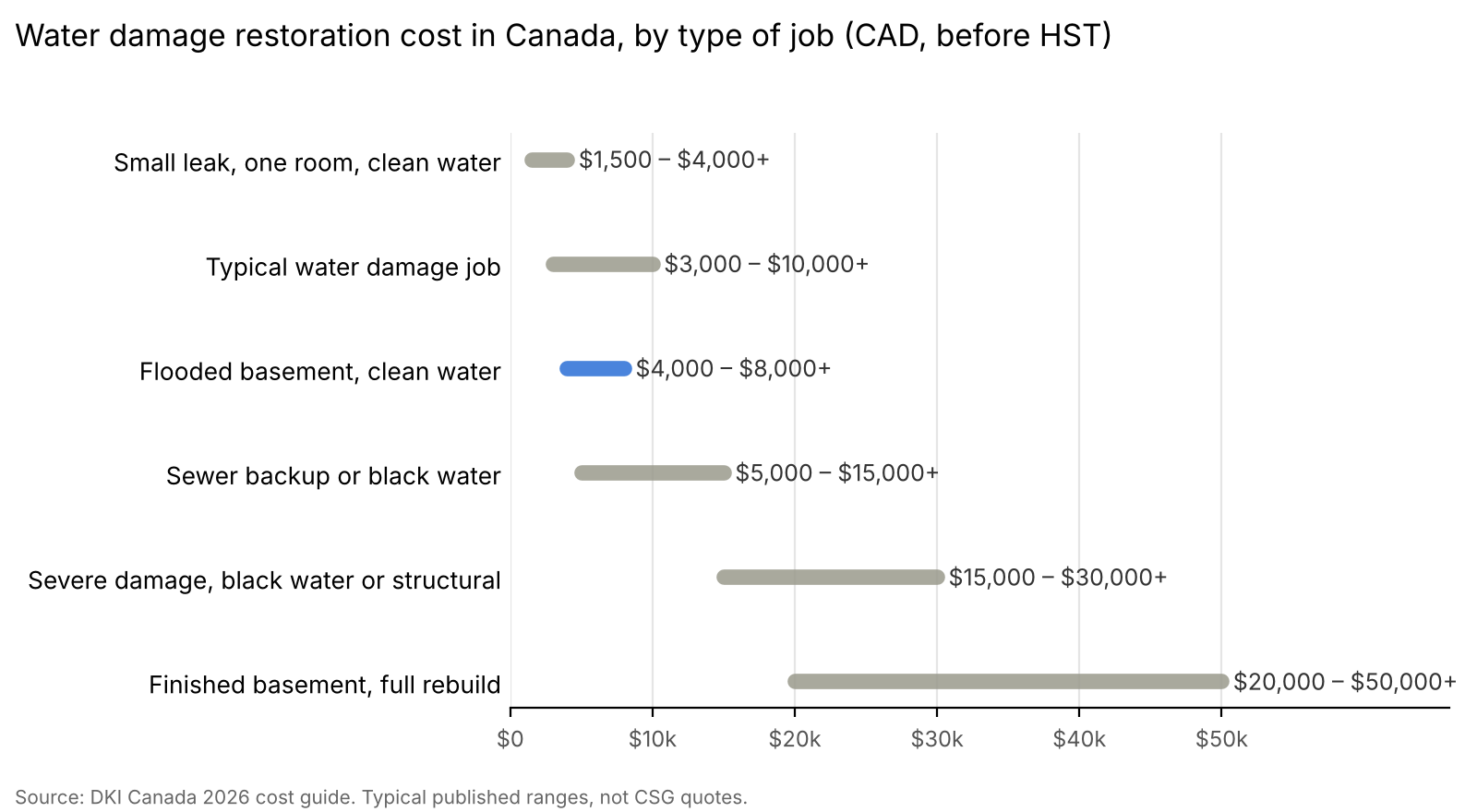
Published 2026 ranges in Canadian dollars, before HST:
| Type of job | Typical cost (CAD, before HST) |
|---|---|
| Small leak, one room, clean water | $1,500 – $4,000 |
| Typical water damage job | $3,000 – $10,000 or more |
| Flooded basement, clean water | $4,000 – $8,000 |
| Sewer backup or black water | $5,000 – $15,000 or more |
| Severe damage, black water or structural | $15,000 – $30,000 or more |
| Finished basement, full rebuild | $20,000 – $50,000 or more |
Toronto prices are in the same range: the same Toronto guide puts major basement or sewage damage at $10,000 – $30,000 or more.
These are typical published figures, not CSG quotes, and many include rebuilding. Your price depends on your home and is confirmed after an assessment.
Cost per square foot
- Mitigation only (water extraction and drying): about $4 to $7 per square foot
- Mitigation plus reconstruction (drying, then new drywall, flooring and finishes): about $8 to $15 per square foot
Per-square-foot prices are a guide only. A small area with sewage can cost more than a large area of clean water, and a finished basement costs more than an unfinished one.
What’s in a water damage restoration bill
- Inspection and moisture mapping. Finding the source, identifying the type of water, and using moisture meters and thermal imaging to see how far the water has spread inside walls, floors and framing.
- Water extraction. Removing standing water with truck-mounted and portable extractors. Typical cost: $500 – $1,500.
- Removing wet or contaminated materials. Carpet, underpad, insulation and drywall that can’t be dried or were touched by contaminated water.
- Structural drying. Dehumidifiers and air movers running for several days, usually 3 to 5, with readings on every visit until materials reach a dry standard. Typical cost: $300 – $3,000.
- Cleaning and antimicrobial treatment, especially after sewage or grey water.
- Rebuilding. New insulation, drywall, flooring, trim, paint and cabinets, matched to the rest of your home.
- Documentation for insurance. Photos, moisture maps, daily readings and drying logs, with the estimate written in Xactimate for your adjuster.
Across the industry, after-hours emergency response can add $300 – $1,000.
Water type: why it changes the cost
The industry standard for water damage restoration, IICRC S500, sorts water by contamination:
- Category 1, clean water: a burst supply pipe, a fridge or dishwasher line. If dried quickly, many materials can be saved. This is the lowest-cost category.
- Category 2, grey water: washing machine or dishwasher discharge, or a toilet overflow without waste. Needs cleaning and antimicrobial treatment, and often removal of carpet and underpad.
- Category 3, black water: sewer backup, a toilet overflow with waste, or outside flood water. Porous materials it touched are removed, and the area is contained and sanitised. This is the highest-cost category. Don’t pump out sewage yourself: it carries pathogens and needs protective equipment.
Water left too long can move up a category. Clean water that sits for days can become grey or black, which raises the cost.
Why the first 48 hours matter
- First 24 hours: water spreads into drywall, insulation and under flooring. Extraction now saves the most material.
- 24 to 48 hours: materials that stay wet start to support mould. Health Canada advises drying a home and its furnishings within 48 hours.
- After 48 hours: more drywall and flooring usually has to come out, and the cost of the job rises.
- Mould already growing: CSG doesn’t do mould remediation. If our inspection finds mould, we’ll tell you so a remediation specialist can remove it before we rebuild.
Common Toronto water damage situations
- Burst or leaking pipe in one room, caught the same day: usually the low end of the range.
- Leak from a condo unit above: often affects two units, and may involve both your insurance and the condo corporation’s. The cost depends on how many ceilings, walls and floors were affected.
- Plumber stopped the leak, but the walls and floor are still wet: drying and a targeted repair are often enough if it’s caught early.
- Basement flood after heavy rain or a sump pump failure: mid-range, more if the basement is finished. See basement flood restoration.
- Sewer backup through the floor drain: high, because contaminated materials must be removed and the area cleaned and treated. If sewage is coming up through a floor drain, call 311: the City can check whether the blockage is in the municipal sewer. See sewer backup restoration.
What Toronto homeowners should know about insurance
Your insurer decides what’s covered. As a general guide in Canada:
- Usually covered by a standard home policy: sudden and accidental water, such as a burst pipe or a failed supply line.
- Usually needs a sewer backup endorsement: sewage or water backing up through floor drains, toilets or sinks.
- Usually needs an overland water endorsement: surface water coming in from outside during heavy rain.
- Often not covered: slow leaks over weeks or months, foundation seepage, and damage from lack of maintenance.
- Condo owners: the condo corporation’s policy usually covers the building and common elements, and your unit policy covers your improvements and belongings. Check your corporation’s declaration and your own policy. Our condo water damage checklist walks through who to call.
Call your insurer as soon as it’s safe to do so, and take photos and video before anything is moved. Don’t wait for the adjuster before drying starts: insurers expect you to limit further damage. CSG writes estimates in Xactimate, the same platform adjusters use, and bills all insurers directly. You pay your deductible and any work your policy doesn’t cover.
Preventing the next basement flood in Toronto
The City of Toronto’s Basement Flooding Protection Subsidy Program helps pay for prevention devices such as backwater valves and sump pumps. Since 1 May 2026, eligible homeowners can receive up to $6,650 per property (City of Toronto). The subsidy covers prevention, not cleanup.
How to get an accurate water damage estimate
- Stop the water at the main shut-off, or call building management in a condo.
- Take photos and video of the water, the source and every damaged item.
- Call your insurer to open a claim.
- Ask for moisture readings, not just a visual check. Water hides inside walls and under floors.
- Ask what’s included: extraction, drying, removal, cleaning and the rebuild, or only part of it.
- Ask who does the rebuild. If the restoration company doesn’t rebuild, you’ll need to hire and wait for a second contractor.
- Get the scope in writing before reconstruction starts.
For the first hour after a leak, see what to do after water damage in your Toronto home. If the water is gone but a concrete floor is left dirty, see how to clean a concrete basement floor after a flood.
About our prices
The prices on this page are typical ranges, not fixed quotes. Every water damage job is confirmed after we inspect it. Your price depends on the type of water, the area affected, the materials, how long they were wet, and access to your home or condo: parking, elevator booking and times, corridor length and building rules. We never do extra work without your written approval.
Why Toronto homeowners choose CSG
- On site within 60 minutes anywhere in Toronto during service hours: Monday to Friday 9 a.m. to 8 p.m., Saturday 9 a.m. to 4 p.m.
- IICRC WRT-certified technicians, working to the IICRC S500 standard
- Our own extraction and drying equipment, so drying starts on the first visit
- Direct billing with all insurers, with estimates written in Xactimate
- Moisture maps, readings and drying logs on every job
- Licensed Building Renovator with $5 million liability insurance
- Condo-board approved, working within building rules on access, elevator bookings and hours
- Drying and repairs by one company, with 18+ years as a renovation contractor
- Rated 4.9 stars by 74 Google reviewers
See our emergency water damage restoration service.
Water damage restoration cost FAQs
How much does water damage restoration cost in Toronto?
At CSG, typical emergency water mitigation costs $1,500 to $3,000 for one area of clean water caught early, and $3,000 to $5,500 for several rooms of clean or grey water, before HST. Across Canada, most jobs cost $3,000 to $10,000, and a sewer backup or full basement rebuild can cost $15,000 to $50,000 or more.
How much does water damage restoration cost per square foot?
About $4 to $7 per square foot for extraction and drying only, and about $8 to $15 per square foot when rebuilding is included.
Does home insurance cover water damage in Ontario?
Sudden and accidental water damage, such as a burst pipe, is usually covered. Sewer backup and overland flooding usually need separate endorsements, and slow leaks are often excluded. Check your own policy.
How long does water damage restoration take?
Drying usually takes 3 to 5 days. A small contained area can take 1 to 2 days, and significant flooding several days to 2 to 3 weeks, including repairs.
How fast can CSG get to me?
We aim to be on site within 60 minutes anywhere in Toronto during service hours, Monday to Friday 9 a.m. to 8 p.m. and Saturday 9 a.m. to 4 p.m. Outside those hours, leave a message or send the form and we’ll call you first thing.
How fast does mould grow after water damage?
Mould can start within 24 to 48 hours on materials that stay wet. Health Canada advises drying within 48 hours.
What’s the difference between water damage and flood damage for insurance?
Water damage usually means water from inside the home, such as a pipe or appliance. Flood or overland water means water coming in from outside, which usually needs its own endorsement.
Who pays for water damage from the condo unit above?
It depends on the cause, your condo’s declaration and both insurance policies. Your property manager can tell you what the corporation’s policy covers.
Key terms
- Mitigation: stopping further damage: extracting water and drying the structure.
- Reconstruction: rebuilding what was removed or damaged.
- IICRC S500: the industry standard for professional water damage restoration.
- Water category: how contaminated the water is, from Category 1 (clean) to Category 3 (black).
- Sewer backup endorsement: an add-on to a home policy that covers sewage backing up into the home.
- Overland water endorsement: an add-on that covers surface water entering from outside.
Need help with water damage?
Request a water damage assessment → · Call (647) 428-0007
See also: Emergency Water Damage Restoration in Toronto · Basement Flood Restoration · Sewer Backup Restoration · What to Do After Water Damage in Your Toronto Home · Condo Water Damage Toronto: A Restoration Checklist
CSG Renovation
Updated November 2026



Your Dream Space, Right on Schedule! Zeev, Founder
Get Free Estimate and get amazing renovation with remarkable speed!
